
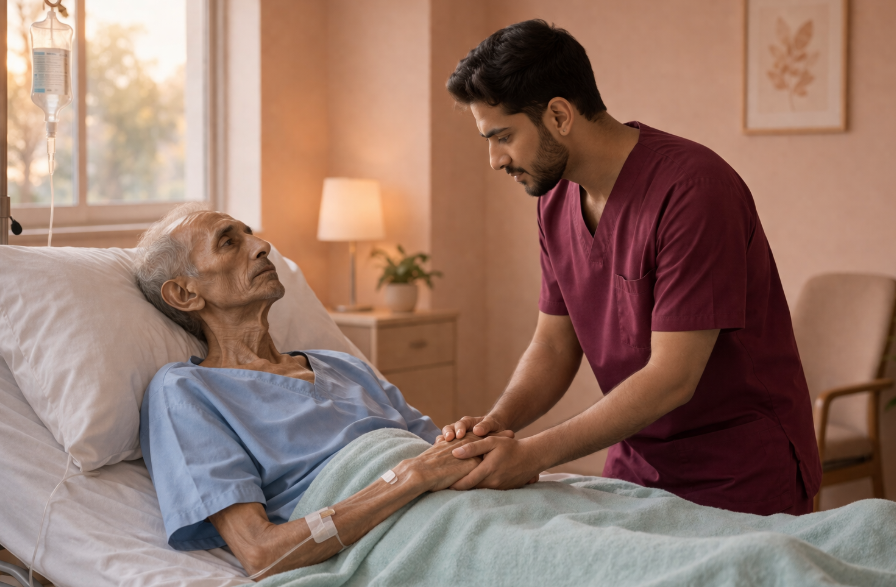
When a family member survives a stroke, the relief is immediate. Then the questions start.
How much will he recover? Will she walk again? Do we bring him home, or find a rehabilitation centre? The stroke rehabilitation decision home-based versus inpatient is one that families in Chennai face with very little guidance and very high stakes. Make the right call and the patient enters an intensive recovery pathway that maximises function. Make the wrong one and weeks of the brain's most plastic, most receptive recovery window pass with insufficient therapy.
India reports approximately 1.8 million new stroke cases every year, according to the Indian Council of Medical Research. Tamil Nadu carries a significant share of this burden, and Chennai's major neurology hospitals discharge stroke survivors daily into families who must quickly answer that question. This article breaks down what both options involve, where each works well, and why for most patients with moderate to severe stroke residential rehabilitation at an established centre produces measurably better outcomes.
Why the First Few Weeks After Stroke Are Irreplaceable
Stroke rehabilitation works because of neuroplasticity the brain's ability to rewire itself after injury by forming new neural pathways. This process is most active in the weeks immediately following a stroke. Research consistently shows that patients who begin intensive, structured rehabilitation within the first two to four weeks after stroke onset recover significantly more function than those whose therapy is delayed or delivered at low frequency.
This is not a minor difference. A patient receiving daily multidisciplinary therapy physiotherapy, occupational therapy, speech therapy, cognitive rehabilitation in the acute recovery window will typically achieve functional milestones that a patient receiving twice-weekly home visits never reaches. The neuroplasticity window does not stay fully open. Families who delay or under-invest in early rehabilitation are not just deferring recovery they are accepting a lower ceiling on what their loved one will ever regain.
What Home Rehabilitation for Stroke Patients Actually Looks Like
Home rehabilitation for stroke typically involves a visiting physiotherapist, sometimes a speech therapist, and family members performing guided exercises between visits. In the right circumstances, it works — for mild strokes with limited functional impairment, patients with very strong family support structures, and cases where the patient has already completed a residential rehabilitation phase and is maintaining gains.
The structural limitations are worth being direct about. A visiting therapist who comes three times a week provides roughly three to four hours of active therapy in a seven-day period. A residential stroke rehab programme delivers therapy every single day, often in multiple sessions across different disciplines. That frequency difference is not a quality judgement about any individual therapist — it is a mathematical constraint of the home model.
Home rehabilitation also places significant clinical burden on family caregivers. Positioning, transfers, fall prevention, medication management, monitoring for post-stroke complications like aspiration pneumonia or DVT — these require training that most families receive only partially, if at all, before hospital discharge. In practice, family caregivers managing stroke recovery at home frequently report exhaustion, anxiety, and uncertainty that directly affects the quality of care the patient receives.
What Inpatient Rehabilitation in Chennai Delivers?
Inpatient rehabilitation Chennai — residential admission to a specialist stroke rehab centre — provides the clinical environment that the neuroplasticity window demands. The patient lives in the centre for the duration of the intensive rehabilitation phase, typically four to twelve weeks depending on severity, and receives daily multidisciplinary therapy as the central activity of their day.
In an established residential stroke rehabilitation programme, a typical day includes physiotherapy for motor control, strength, and gait; occupational therapy for functional independence in daily tasks; speech and language therapy for aphasia, dysarthria, or swallowing difficulties; and cognitive rehabilitation for attention, memory, or executive function deficits. These disciplines work together — not separately — with the clinical team meeting regularly to review each patient's progress and adjust goals.
Beyond therapy, residential care provides what home rehabilitation structurally cannot: 24-hour nursing by staff trained in neurological care, physician oversight with daily or as-needed reviews, a safe and adapted physical environment that reduces fall risk, and nutrition managed by a dietitian. Post-stroke patients are at elevated risk for several serious complications — seizures, aspiration events, falls, secondary strokes — that require trained clinical response, not a family member calling a helpline at midnight.
Why Established Care Homes and Rehabilitation Centres Outperform Smaller Providers
Chennai has a range of stroke rehabilitation options from small physiotherapy clinics offering domiciliary services to established residential care homes with dedicated neuro rehabilitation programmes. The difference in what these settings can actually deliver is significant, and families choosing based on proximity or cost alone frequently discover this only after recovery has already been compromised.
Established residential centres bring institutional depth that smaller providers structurally cannot match:
- Evidence-based stroke protocols not generic rehabilitation programmes applied to all patients, but condition-specific pathways aligned with clinical research. Established centres refine these protocols over hundreds of stroke cases, building clinical pattern recognition that directly influences outcomes.
- Multidisciplinary team co-ordination physio, OT, speech therapist, neuropsychologist, nursing, and dietitian working from a shared care plan reviewed in team meetings. In small clinics, these disciplines often operate in isolation, if they exist at all.
- Scale and case volume a centre that has managed hundreds of stroke rehabilitation cases develops clinical expertise that is genuinely different from a provider managing a handful. Therapists who have seen a wide range of stroke presentations read recovery trajectories more accurately and adapt programmes more effectively.
- NABH accreditation India's national healthcare quality benchmark. Accredited facilities maintain documented clinical protocols, qualified staffing standards, infection control practices, and regular internal audits. These are not administrative formalities they are the structures that make consistent, high-quality care possible at scale.
- Geriatric specialisation — the majority of stroke patients in India are over 60. Established care homes with geriatric clinical leadership manage the additional complexity of stroke recovery in older adults: polypharmacy, comorbid cardiac and metabolic disease, cognitive vulnerability, and higher fall risk. These are not incidental factors they directly shape what rehabilitation is clinically appropriate. For a family in Chennai weighing options, the question is not just where the patient will be comfortable. It is where the patient will recover the most function and the evidence consistently points toward established residential rehabilitation over fragmented home-based alternatives for moderate to severe stroke.
When Home Rehabilitation Is Genuinely Appropriate?
Acknowledging this fairly matters. Home rehabilitation for stroke is genuinely appropriate in specific circumstances, and steering families toward residential care when it is not needed serves nobody.
Home rehabilitation works well when the stroke was mild, with limited physical and cognitive impairment; when the patient has already completed an inpatient rehabilitation phase and is maintaining and building on existing gains; when strong family caregivers are present, trained, and able to sustain the daily exercise regime; and when the patient is medically stable with low complication risk.
Outside these conditions — moderate to severe motor impairment, significant speech or cognitive deficits, medical instability, limited family capacity, or early in the post-stroke recovery window residential inpatient stroke rehabilitation in Chennai is the clinically appropriate choice. Families who choose home rehabilitation under these conditions are not wrong to want to care for their loved one at home. They are simply doing so in a setting that cannot support what the patient's brain actually needs.
Making the Decision: What Families in Chennai Should Weigh
The stroke rehabilitation decision is not just medical — it is emotional, logistical, and financial. Families carry guilt about placing a parent or spouse in a residential setting. They worry about cost. They want to be the primary caregivers themselves. These are understandable impulses, and good stroke rehabilitation centres in Chennai acknowledge them.
What helps families make this decision well is reframing it. The question is not: am I giving up on my loved one by choosing a care home? The question is: does this setting give my loved one the best clinical chance in the weeks when it matters most?
For moderate to severe stroke in the acute recovery window, that answer is almost always inpatient rehabilitation at an established residential centre. The daily therapy intensity, the clinical oversight, the multidisciplinary team, the 24-hour nursing — none of these can be replicated at home. Families who choose residential rehabilitation are not withdrawing their care. They are directing it where it produces the most recovery.
Financial concerns are legitimate and worth addressing directly. Many NABH-accredited rehabilitation centres in Chennai work with major health insurers, and a significant number of post-stroke inpatient rehabilitation stays qualify for health insurance coverage when admitted following a covered hospitalisation. Centres with dedicated insurance support teams simplify this process considerably — families should ask about this explicitly when evaluating providers.

 Arabic
 French
 Spanish
 Portuguese
 Deutsch
 Turkish
 Dutch
Dutch
 Italiano
 Russian
 Romaian
 Portuguese (Brazil)
 Greek
Greek